Entry Indices Order in Indices and Limit Indices Order in Indices
Limit order definition - Entry limit is an order to buy or sell a Indices at a certain stock indices price which is a retracement level where stock indices price is predicted to pull-back to before resuming the original Indices trend. Indices traders use them to buy or sell at better market price. These types of orders are available in most of trading softwares, for our example we will be using MT4 stock indices trading software.
An entry of this type can be used to buy below the stock indices trading market level (up indices trend market retracement) or sell above stock indices trading market level (down indices trend stock indices market retracement).
Buy limit - When buying, your entry buy limit is executed when stock indices trading market falls to your set indices price. (retraces down)
Sell limit - When selling, your entry sell limit is executed when stock indices trading market rises to your set indices price. (retraces up)
Entry orders are placed by indices traders when they expect stock indices price to bounce back after reaching this area.
- Entry Buy Limit Indices Orderbuy at a level below the current market level.
- Entry Sell Limit Indices Ordersell at a level above the current market level.
Buy Entry Limit Example
In the stock indices trading examples explained below, the buy limit order was placed to buy at a indices price below the current market indices price. Point B is point at which it was set.
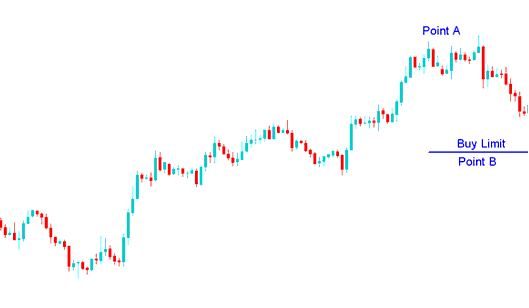
Limit buy order entry placed to buy below current market indices price
The stock indices price then retraced and went down to hit buy entry limit, and afterwards stock indices price continued to move upward in direction of the original Indices upward indices trend. When the limit buy order was hit it changed into a buy.
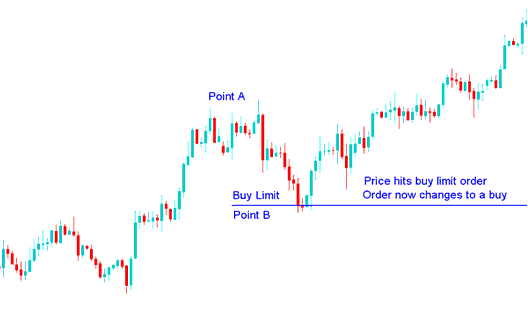
Indices Price hits buy limit, order now changes to a buy
Sell Entry Limit Indices Order
In the stock indices trading example explained and illustrated below a the sell entry limit was placed to sell at a indices price above the current market indices price. This is the level for the stock indices price retracement.
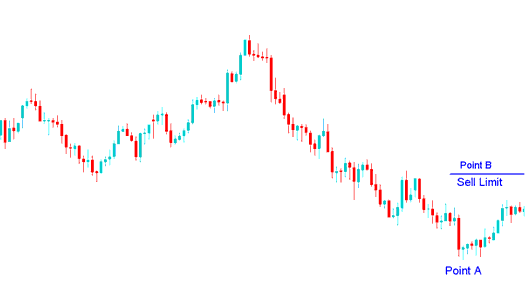
Entry limit sell order placed to sell above current market indices price
The stock indices price then rallied, went up to hit sell entry limit, and afterwards stock indices price continued to move downward in direction of the original Stock Indices downwards trend.
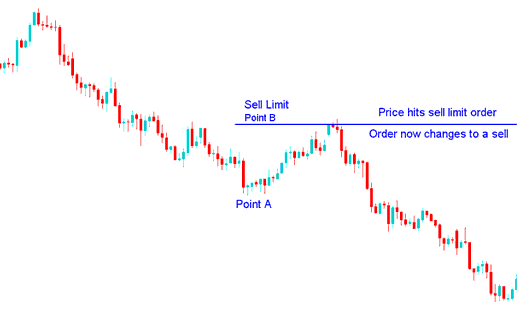
Indices Price hits sell limit, order now changes to a sell
When indices trading quote got to the set level the trading order changed in to a sell, this is therefore a nice technique to buy or sell at a better stock indices price after a retracement move.
Setting Buy and Sell Limit Indices Orders on MetaTrader 4 Platform
To set up these stock indices orders in MetaTrader 4 software, Right-click on Indices chart>>> Choose "Trading">>> Then Select "New">>> Then on the popup panel that pops up (illustrated below), under label "Type" select option of "pending" instead of "market execution">>> Under the pending stock indices order options select the pending stock indices order type: for This trade choose either "Buy Limit Indices Order" or "Sell Limit Stock Indices Order" depending on whether you want to place a pending buy or sell.
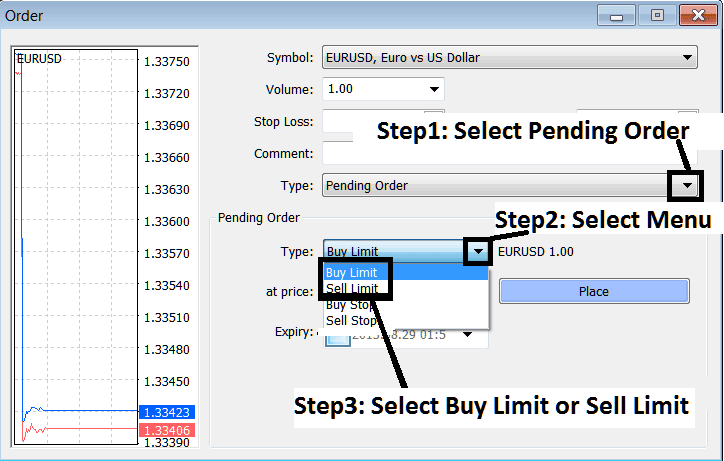
Setting Buy & Sell Limit Indices Orders on MetaTrader 4 Software
Sometimes, setting the point value to place your trade can be tricky, setting to far might mean your entry market limit not getting executed, the best tool to use is Fibo retracement indicator and use the 38.20% retracement levels. This retracement level is watched by many traders and entry orders tend to crowd at this level, therefore the best odds to catch a trade would be presented by using the 38.2% Fibo retracement level.
Fibonacci Retracement Tutorial - Fibonacci Retracement Tutorial
Tip: in Indices online trading, If you want to set a good take profit level (not retracement level, take profit level) for your trades you can use the Fibonacci expansion 100% level for the best take profit area. To Read more on Stock Indices Trading Fibo Retracement and Fibo expansion use the right navigation menu section Technical Analysis.
Fibonacci Expansion Tool Tutorial - Fibonacci Expansion Tool Tutorial
