How Do You Analyze Fibonacci Expansion Levels in Indices Trading?
Stock Indices Trade Fibonacci Expansion Levels in Indices Trading
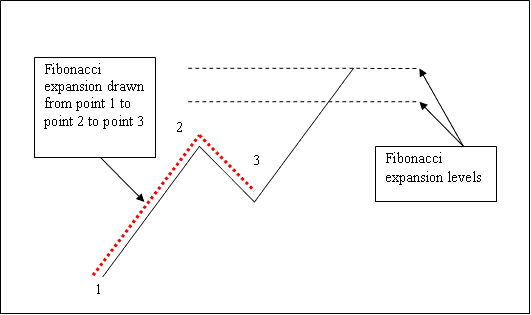
Fibonacci expansion indicator is drawn using 3 stock chart points.
To draw Fibonacci Expansion levels on indices charts we wait until the stock indices price retracement is complete and the stock indices price starts to move in original direction of the Indices trend. Where the stock indices price retracement reaches is used as stock chart point 3.
The Fibonacci expansion stock indices trading example explained and illustrated below shows the 3 Indices Chart Points where the Fibonacci expansion indicator is drawn, marked as Indices Chart point 1, 2 and 3. Indices Chart point 1 is where the indices trend started, Indices Chart point 2 is where the indices trend pulled back & retraced and Indices Chart point 3 is where the stock indices price retracement reached as shown on the Fibonacci Expansion Indices Trading Tool stock indices trading examples explained below.
Fibonacci Expansion Strategy using Fibonacci Expansion Areas
Please note where these Fibonacci Expansion zones are plotted on the stock indices chart - Fibonacci Expansion zones are plotted above the Fib Indices Indicator, these are the points where the trader will set the indices take profit orders using these Fibonacci Expansion Levels - 61.8% and 100% Fibo Expansion Levels.
Drawing Fib Expansion Levels on an Upwards Indices Trend
We use Fibo expansion areas to estimate where the market trend movement will reach. There are 2 important Fibo expansion areas: 61.8% and 100% Fibonacci Expansion Levels, these Fibonacci Expansion Levels are used for taking indices profit.
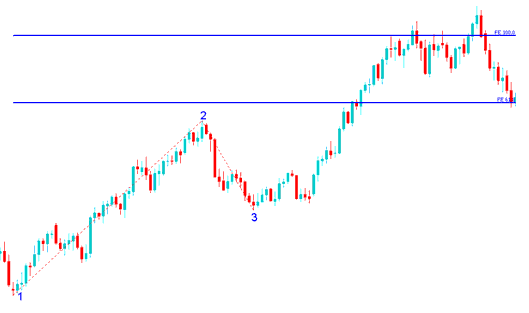
On the Fibonacci expansion stock indices trading example explained and illustrated below you can see that the Fibonacci expansion stock indices technical indicator is plotted along the direction of the trend, since the trend is upwards - the Fibonacci expansion stock indices indicator is drawn upwards.
These Fibo expansion levels are displayed as horizontal lines above Fibonacci Expansion indicator, showing profit-taking areas. In the stock indices trading example explained and illustrated below if you had used of 100% Fibonacci expansion level you would have made nice indices profit from the indices trade setup.
Fibonacci Expansion Strategies in Indices Trading
From the above Fibonacci expansion indices trading examples, the upward trend continued and both 61.8% and 100.00% Fibonacci expansion levels were all hit after which stock indices price retraced again after getting to the 100.0 % Fibonacci Expansion level.
Drawing Fib Expansion Areas on a Downward Indices Trend
Since we use this Fibonacci expansion indices trading tool to estimate indices take profit levels, how do we draw it in a downwards Indices trend?
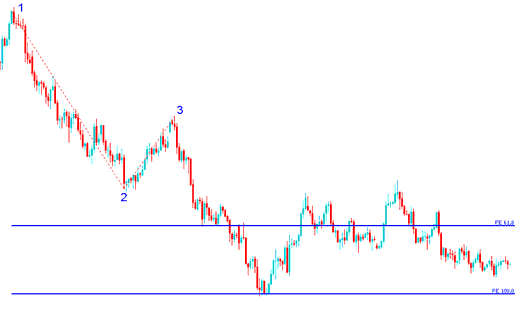
We draw the Fibonacci expansion stock indices indicator from stock chart point 1 to 2 to 3 as shown below. Remember we always draw this Fibonacci expansion indices trading tool in direction of the stock indices trend. In the Fibonacci expansion stock indices trading example explained and illustrated below, can you figure what direction we have drawn it? That is right - downwards direction.
Try & identify the difference between how we have drawn Fibonacci expansion levels above and how Fibonacci Expansion Indicator is drawn below. This time you would also have used Fibonacci expansion level 100%, just where the stock indices price reached as shown on the stock indices trading example explained and illustrated below. That would have been a nice indices take profit area.
Fibonacci Expansion Strategies in Indices Trading
From the Fibonacci expansion stock indices trading example above, after plotting this Fibonacci expansion tool there are 2 levels that are used to show the indices profit taking areas, these two Fibonacci expansion levels on the indices indicator are drawn as horizontal lines across the trading stock indices price chart.
How Do You Interpret Fibonacci Expansion Levels in Indices Trading?
